

Saturday night, more than 160 people came together for the inaugural Shootin’ & Scootin’ for Justice, proving that protecting children isn’t the responsibility of one person or one agency—it’s the responsibility of an entire community.
By the end of the evening, that community had raised $50,303 for the Child Advocacy Center of Central Oklahoma (CACCO), ensuring children in Pottawatomie and Lincoln counties who have experienced abuse will continue receiving forensic interviews, advocacy, medical services, and the support they need to begin healing.
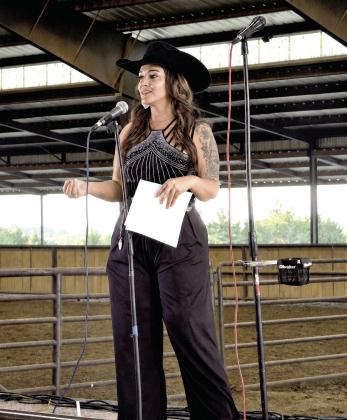
Hosted by founding CACCO Board President Melissa Dennis and current Board President Rachael Melot, the western-themed fundraiser featured trick riding, mounted shooting, live music, dinner, a silent auction, and a spirited live auction. But while the entertainment filled the arena, the evening’s true purpose never left center stage.
Executive Director KC Campbell challenged those in attendance with a simple question.
“What does justice mean to you?”
“Most people, when they think about justice, think about a courtroom,” Campbell said. “They think about a judge and a jury.”
For years, she admitted, she believed the same thing.
That changed during the trial of a man accused of sexually abusing his stepdaughter.
Campbell said, during closing arguments, the defense attorney urged jurors to return a verdict that reflected what the community believed the defendant deserved.
Then Campbell explained, the prosecutor, Assistant DA Lori McConnell, stood and said, “I agree. Return a verdict that is a representation of our community and what we believe should happen when a child is brave enough to step up and share what they have been through and what they have experienced.”
“The jury returned three of four guilty verdicts,” said Campbell. “The judge ordered the sentences to run consecutively, ensuring the offender would never again walk free.”
At that moment, Campbell said that just the verdict no longer defined justice.
“It changed all the things I thought about justice,” she said. “Before then, I really did think it was a matter of what happened in that courtroom.”
Instead, she realized justice had begun months before anyone entered the courthouse.
It began with investigators who refused to take shortcuts. Medical professionals who carefully documented evidence. Forensic interviewers who patiently listened. Child welfare workers who remained focused on protecting a child every step of the way.
“They weren’t talking about those 12 jurors,” Campbell said. “They were talking about us. They were talking about the community. They were talking about our multidisciplinary team and all of the things that had transpired prior to us ending up in that courtroom.”
Justice, she said, belongs to everyone.
“We can’t do it alone. It’s not just a forensic interviewer. It’s not just a Child Advocacy Center. It’s not just law enforcement or child welfare workers. That’s not what makes up justice.”
“It’s everyone. It’s everyone doing their part.”
That message has become even more personal during Campbell’s four years as executive director.
Again and again, she said, children have shared the same heartbreaking words during forensic interviews.
“I told someone ... and nothing happened.”
“There is nothing sadder than a child who was brave enough to step forward and say, ‘I’m being abused,’” she said. “Some of them even said, ‘I’ve been to the Child Advocacy Center, and nothing happened.’ They were placed back in that home environment, and that is unacceptable.”
Determined to change that, the Child Advocacy Center strengthened its multidisciplinary team, expanded partnerships throughout the community and worked to eliminate gaps that created additional trauma for children.
“We went from serving about 300 kids a year to over 1,000 now,” Campbell said.
“But that’s 1,000 children whose voices were never heard before.”
Instead of being interviewed in homes or near those accused of hurting them, children now have a safe place where they can tell their story, while law enforcement, medical professionals, child welfare workers and prosecutors work together under one roof.
“These kids truly have a chance at justice,” she said.
One story continues to remind Campbell why that work matters.
The child arrived at the Child Advocacy Center after enduring years of abuse by her biological father. During her emergency forensic interview, she disclosed very little.—“Not because she was lying,” said Campbell, “But because she didn’t yet understand that what she had experienced was abuse.”
She returned a couple of weeks later.
This time, she found the words.
The Child Advocacy Center stood beside her through every step of the court process until the day she looked her father in the eye and told him he would never have power over her again.
She chose to take her stepmother’s last name, symbolizing the life she had chosen beyond the abuse.
Campbell said, “Instead of allowing her past to define her, the young woman rewrote her story—not as a survivor, but as an overcomer.”
“You see,” Campbell told the audience, “justice isn’t built in just a single moment. It’s built by each moment that we choose to do the right thing.”
Looking around the room, she reminded guests that they, too, were part of that story.
“So I want to ask y’all one more time,” she said. “What is justice? Because tonight, y’all get to decide that.”
By the end of the evening, the answer could be seen throughout the arena.
It was in the volunteers who spent months planning the fundraiser. The sponsors who generously supported the event. The businesses and individuals who donated auction items. The families who filled tables. The bidders who eagerly raised their paddles. Every act of generosity became another step toward justice for a child.
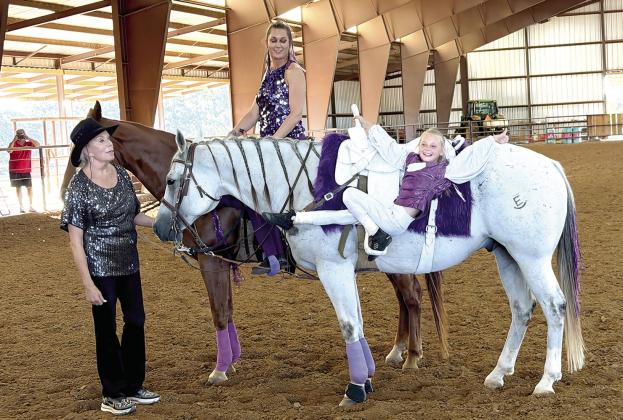
The western-themed evening featured impressive performances by eight-year-old trick rider Jenson Dockery, daughter of Mandy and Shane Dockery. After just four weeks of lessons, Jenson and her horse captivated the audience with a series of daring maneuvers that drew cheers from every corner of the arena.
Mounted shooting competitor Amy Moon followed with a fast-paced demonstration on horseback, showcasing the speed and precision of Cowboy Mounted Shooting, before the evening transitioned into live music by Dirt Rich and dancing.
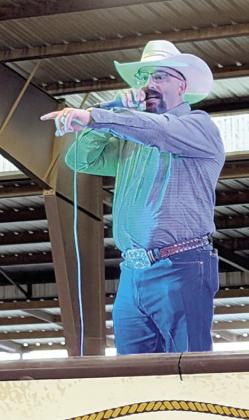
Following the western performances, attention turned to the live auction, where District Attorney Investigator Tony Foreman served as auctioneer, leading spirited bidding on more than a dozen donated items, ranging from custom hats and vacation packages to original artwork, outdoor equipment, and a Toro zero-turn mower.
Each bid represented far more than a winning purchase.
It represented another child who will be heard.
Before auctioning a colorful rainbow bison painting created by Oklahoma artist Zacharyah Lee Jones, Foreman paused to explain why the bison has become the Child Advocacy Center’s symbol.
“The bison is kind of a mascot of the Child Advocacy Center, and there’s a reason they picked the bison,” Foreman said.
“When storms come, most animals run away. The bison huddle together, turn and face the storm.”
He said the Child Advocacy Center responds the same way.
“The Child Advocacy Center is like the bison for the children,” Foreman said. “They walk into the storm because the fastest way, the strongest way through it, is to hit that storm head-on and walk through it.”
That’s exactly what happened Saturday night.
More than 160 people chose not to run from the storm.
They faced it together.
By the time the final paddle was lowered, those efforts had become $50,303—funds that will help ensure the next frightened child who walks through the doors of the Child Advocacy Center of Central Oklahoma won’t have to face the storm alone.
Saturday night, justice was built by a community that chose to stand together for its children.
