

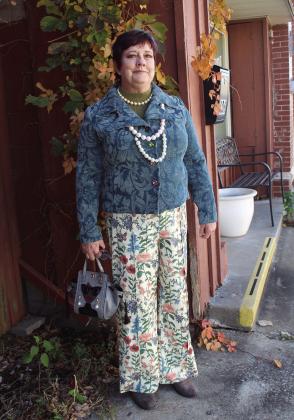
When Fran Topping was 14, she gazed at her grandmother’s photographs of her uncles in military uniform and wondered why there were no photos of women.
It was then she decided to become that woman in uniform she wished to see. Life went on. Topping graduated from Tecumseh High School in 1981, and her dream changed to being a fashion designer or a forest ranger. She even took Fashion Design and Production at Gordon Cooper Vo-Tech (now Technology Center). Topping was actually accepted into a fashion design school, but was unable to go because of tuition.
Then, she heard about a friend’s brother who “got to fly to cool places” in the National Guard, and she remembered her original dream. Topping had one se-mester of college under her belt when she called a recruiter from a pay phone on campus.
“I … didn’t realize that the friend who got to fly places was in the Air National Guard, and I called the Army National Guard,” said Topping.
During basic training, Topping fondly recalls Miss Puerto Rico - who had joined with three other women from the island - singing them to sleep.
Joining the military in a time when women rarely did, Topping said she was lucky that most of the “gentlemen … behaved as gentlemen.”
“There were times that … the people were not appropriate,” she said. “But I was fortunate enough to be able to either deal with it myself or have somebody watching my back.”
Following basic, Topping went to school in San Antonio to become a medic and operating room technician. That’s when her education really began.
Upon finishing her on-the-job training, she returned to Oklahoma, where she briefly worked at a local nursing home.
Then, her medical unit in Midwest City was offered X-ray school back in San Antonio. She trained at Brooke Army Medical Center (BAMC) at Fort Sam Houston and still has vivid memories.
One of her duties was to take the portable Xray machine to the Neonatal Intensive Care Unit (NICU) to check premature infants’ lungs.
Around that time, the Marine barracks in Beirut were bombed, and some of the severely burned soldiers were sent to BAMC for their “premier burn unit,” said Topping.
She still becomes emotional remembering the day she was Xraying a burn victim when his parents came into the room and saw him for the first time since the bombing.
“First, it was my real exposure to war and … severe wounds, and it also maybe … for the first time I could say, ‘Boy, you know what, I’m doing this compassionately, but dispassionately at the same time’... because ... you have to step back to be able to do those things, and to see parents seeing their son … and I was in there doing an X-ray and, you know, just the absolute shock and horror,” said Topping.
“I was like, ‘So, that’s what it’s like to be a mother. That’s a big thing.’ And it also made me realize, ‘Well, this is why my parents are always so worried about me,’ and you know, when you’re 19, you’re gonna live forever.”
Topping said, after her experiences at the hospital, the people she graduated with seemed like children, and she felt much older when she came back to Tecumseh.
Topping married an Army soldier and moved with him to Alabama where she switched to working in personnel for the Guard.
“So, I think one of the things that made me realize is that I was not the sort of person who could permanently just disassociate,” she said. “So, I can do it on the job, but then at the end of every day, it just hit me.”
After a couple years, they returned to Oklahoma, and Topping took a temporary job at the Oklahoma National Guard Headquarters in OKC, filling in for someone on maternity leave in the purchasing department. During that time, she accepted a full-time position in the Operations and Training department, from which she would retire.
A subdivision of that being mobilization readiness, Topping was part of the “military support to civil authorities” during natural disasters.
On the day of the Alfred P. Murrah Federal Building bombing, April 19, 1995, Topping was preparing for a meeting at the State Capitol between the State Adjutant General, the civil defense officer, and the Governor and his Cabinet.
“We spent three days sweating this briefing … that was so important, and then all of a sudden, it didn’t matter, you know, it didn’t matter at all,” she said.
Topping was waiting outside by a car when the bomb went off.
“You know, this was the time of pagers, not cell phones,” said Topping. “So, there was no getting a quick update from inside that said … stand by, sit tight, or … take the car and go pick up somebody or you know, go back … I mean, just standing outside waiting to know what’s going on.”
“Well, I mean, you knew something. You could see smoke. You know something big has happened. So, eventually … the word got even out to us that that’s what had happened.”
Topping served as an Emergency Operations Non-Commissioned Officer (NCO) and sent whatever or whomever was needed from the military Emergency Operations Center (EOC) to assist those working at the Murrah site.
“One of the agencies would call and say, ‘We need 100 people with some forensic experience,’ or, you know, ‘graves registration to help at this site,’ or ‘we need ... this many MPs and some water trailers here,’ ” said Topping.
She was also responsible for sending food and water.
“Of course, a lot of the restaurants were feeding also, but under the law, you know, we had an obligation to provide the food,” she said.
Topping remembers working for two days straight at the EOC, as her parents took care of her daughters. She came home to change clothes and see her children before returning the next day. When she stopped for breakfast at a Mc-Donalds, she said the reaction to her uniform reflected the public’s respect.
“As I started to walk to the door, the doors opened, and there are all these people in there, and they just made this path for me to come through … to order my Egg McMuffin and coffee because … I was in uniform,” she said.
It was a drastic change from a few days before the bombing when her car died in the middle of an intersection, and people watched from their cars as she pushed it into a parking lot.
Later, Topping was a computer operator for the worldwide military command and control system.
“Sounds really fancy,” she said. “ ... It’s a secure computer: TTY, as in, … if you made a typo, you had to … correct that many spaces and start all over again, in your programming and stuff.”
“But it was a top secret computer, and that’s where mobilization and alert orders came. So during Desert Storm, I was the first person in the state to know if a National Guard unit had been alerted or mobilized.”
In her last few years, Topping became a traditional, part-time Guardsman, and taught Franklin Covey leadership classes.
When she retired from the military as a Sergeant First Class after 21 years, she continued teaching leadership classes at Gordon Cooper Technology Center. She taught Leadership and Organizational Development classes to area businesses for the next 22 years. She has also used her 4-H training - learned as a child and a parent - to teach Canning and Cheese Making classes, with the occasional Upholstery class.
Topping has also come back to her fashion design roots, and has an Etsy business in repurposing vintage clothing, called Mimzically Delicious. Plus, she and her husband of the last 20 years, Craig McIntire, own spOKeLAHOMA, in Tecumseh.
When asked if she’s glad she served, Topping said, “Absolutely. For one thing, I am patriotic, and that was quite true, then and now … that was why, and plus the pictures. … And then just meeting so many people. I think it really opened me up to the reality that … my picture of the world is very small.”
