

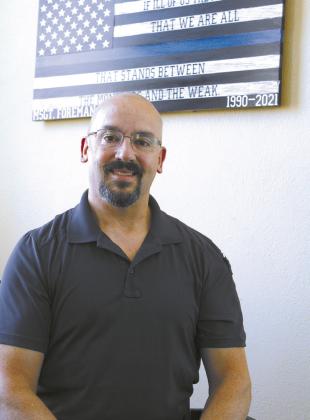
Tony Foreman never wanted to go into child abuse investigation - not because he didn’t want to protect children, but because he didn’t know how he would control his temper while listening to the alleged perpetrators.
“ My captain said, ‘Tony, take a deep breath. I think if you’ll give it a chance, it’ll get in your blood, and you’ll realize how valid the work of child abuse investigations is,’ ” he said.
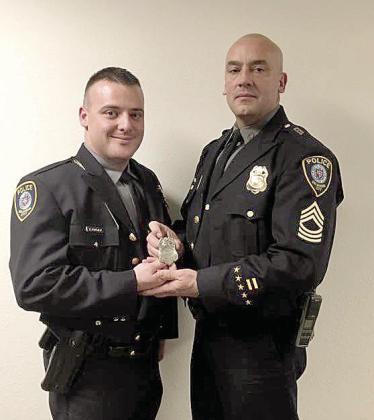
Foreman followed his calling and spent 10 years in the Crimes Against Children division of the Oklahoma City Police Department. He retired as a Master Sergeant after 31 years with the OKCPD in 2021.
Foreman is a Dale graduate and has lived in Pottawatomie County for most of his life. Two years into retirement, he found a way to continue his calling and serve his own community.
Foreman had crossed paths with Adam Panter in the past, and when Panter became Judicial District 23 District Attorney, he decided to talk with him about a job. Foreman also knew Child Advocacy Center of Central Oklahoma (CACCO) Director Kaycee Campbell from her childhood.
So, on Sept. 1, 2023, Foreman began serving as a DA Investigator, under Investigator Jason Holasek. He specializes in child abuse investigations and is housed at the CACCO in Shawnee, covering cases in Pottawatomie and Lincoln counties.
Rather than be stationed at the Lincoln County courthouse, as investigators had been in the past, Foreman asked to be in Shawnee, because he believed he “could have a whole lot more impact on all of the cases that came in.”
“With my cases, I’m all-in, like this case … these kids become my kids, and so I take them real personally, probably too personally,” he said.
Foreman is a member of the Multidisciplinary Team, which conducts forensic interviews with victims of physical or sexual child abuse.
He said he usually doesn’t speak to the children, but there was one girl with whom he made a friend.
“She was scared that somebody was going to come back and get her,” said Foreman. “That was a long, drawn-out case.”
“ … There’s a lot to it, and she was really scared. So I had met her early on assisting Lincoln County, and one of the original suspects, his name was Tony, as well. So when she first met me, she’s like, ‘I don’t think I can talk to you because your name’s Tony.’ I was like, ‘You’ve got to understand, you can call me Investigator … Detective … or whatever you need to call me so that you can feel safe. But I’m here to fight for you, and I will protect you, and nobody will hurt you.”
“And so, she began to trust that somebody was going to fight for her for a change, and because of that, then she was willing to talk to the forensic interviewers and do those things because she … felt like she was safe. And that’s the whole point of a child advocacy center. It’s a safe spot where they feel protected, where they feel believed, where they feel encouraged to come forward with their truth so that they can be made safe.”
Unfortunately, Foreman said, many children who tell someone about their abuse are made to tell their truth over and over again before they come to the CACCO. And, by the time they get to the forensic interview, they feel doubted and don’t trust them.
“Now ask a 7, 8, 9, 10-year-old child, 12-year-old child, to talk about that subject (sexual abuse), and now they’ve already been questioned about that subject six or seven times before you get to the forensic interview process,” said Foreman. “And now … they know at this point they’ve been picked up by law enforcement, a DHS worker, their parents have - probably the non -offending parent’s probably been notified - and now their whole world seems like it’s falling apart, and their friend, that they told in confidence, just betrayed their confidence because they told. Do you really think they want to tell us when they get here, and God love our forensic interviewers, they do a hard job, and they do a phenomenal job with it. I’ve been through forensic interviewing school twice.”
The best way to prevent child abuse, said Foreman, is to believe the victim when they come forward.
“Be aware, and if you see something, say something,” he said. “If you hear something, say something, and believe the children, if they tell you something. I think that’s really big ... and don’t question the child about that. If a child comes forward and says that they’ve been touched inappropriately or they’ve been injured or hurt, don’t sit and question them about it. Don’t make them feel like they’re doubted.
My advice to everybody, to every parent … is, if a child comes forward and tells you that they’ve been offended against, whether physically, sexually or otherwise, your response should be, ‘I’m so sorry that happened to you. Let me call some people and see if we can help make sure that it doesn’t happen again.’ ” Those in Oklahoma may be unaware that everyone is a mandatory reporter by law.
“Every person that has a reason to believe that a child has been physically or sexually abused has a requirement of law to make a report to DHS,” said Foreman.
Panter and the state legislators are working on making the DHS (Department of Human Services) legally responsible for reporting any child abuse. According to fastdemocracy.com, HB 1565 would require the DHS to report all child abuse or neglect to law enforcement, even cases that involve a third party, such as a neighbor or extended family member.
“There’s hundreds every year, if not 1000s, of referrals that don’t end up getting assigned out to law enforcement for investigation, but you still had a child offended against, and so our district attorney, Adam, has taken a really strong stance and had some talks with DHS, and now all of the referrals that are screen outs and aren’t assigned, and even the ones that are being assigned are now being sent over to the Child Advocacy Center so the multiple disciplinary team can take a look … at them,” said Foreman.
Very few children actually report their abuse because many have been groomed since they were toddlers. They may have mixed feelings about wanting the abuse to stop, but loving their family member/abuser. Plus, other family members may not be supportive.
During a trial, Foreman has the burden of educating the jury, who may also doubt the child. Foreman goes to the child’s house and takes measurements and pictures of their room to corroborate their statements, showing that the child didn’t lie while describing their surroundings, so why would they lie about what happened to them?
He must also explain that physical exams may come back normal because injuries heal quickly.
For alleged perpetrators, the price is high. Foreman said, if they settle out of court, they could receive life with the possibility of parole, but if they follow through with the trial, they may get life without the possibility of parole.
Foreman has also dealt with online exploitation, which involves studying the victim’s phone, sending preservation letters to social media outlets, and getting search warrants to seize the alleged perpetrator’s electronic devices.
He said once, they requested files from Google, and they responded with encrypted files, which required an expert to decipher.
Foreman said he maintains his own sanity by going to church, talking to his pastor and his wife, and working out at a gym.
“(I) just wake up every day and remind myself why I do this,” he said. “And it’s about, you know, trying to find the truth of these kids, trying to find justice for these kids.
You know, before I CYAN
CYAN
left Oklahoma City, I was back on the street and mentoring kids at a local boxing gym where I could, I mean, it’s all about making a difference for people. That’s why I do what I do. I want to protect the most innocent amongst us.”
Another way Foreman gives back is by teaching his specialty.
“I’ve taught nationally. I taught for OJJDP, doing child death investigations, child homicide investigations,” he said. “I’ve taught sexual abuse investigations for years, and still teach.
I teach for the Zero Abuse Project, for the Child First Protocol that trains forensic interviewers. I teach the cooperative investigation block of that and have taught for the CLEET Investigators Academy that JR Kidney from Tecumseh PD has hosted the last couple of years. I go down and teach the child abuse investigations block for them.”
BLACK
BLACK
