

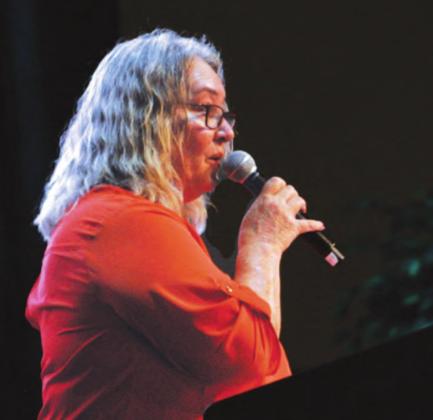
“Domestic violence knows no boundaries. There is no typical stereotype to identify possible victims,” Countywide & Sun publisher Suzie Campbell said.
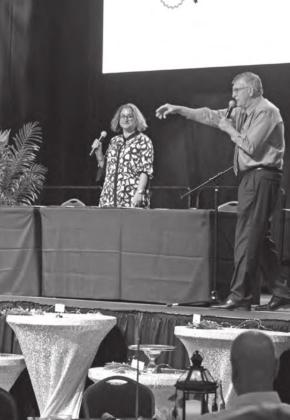
Campbell shared her story during the 13th Annual Honey Do Auction, Oct. 1, hosted by the Women’s Volunteer Auxiliary of Project: SAFE, in conjunction with National Domestic Violence Awareness Month.
“He walked in with a gun, pointed it between my eyes, and said, ‘I talked to my priest today and he said it was wrong for you to divorce me. So we’re going to meet our maker and find out’,” she said.
She credited her family with helping her survive that situation.
“Project: SAFE is very near and dear to my heart,” Campbell said. “There are a lot of reasons to give to this. And everybody doesn’t have the family that I had to help me, so they need other people to help them, and I hope you all will do that.”
Through a combination of silent and live auction sales, table reservation proceeds, and donations, the event raised approximately $45,000.
These funds will go directly toward helping Project: SAFE’s clients, such as paying for gas, auto repairs, and work clothes; replacing driver’s licenses, IDs and birth certificates; and covering school supplies and medical costs.
“We have a wide variety of needs,” Project: SAFE Executive Director Renée Clemmons said. “Our clients come in, and they may not have anything with them at all.”
Project: SAFE is a local non-profit organization that offers free services and support to victims of stalking, domestic violence, and sexual assault, including a shelter and a 24- hour crisis hotline: 800-821-9953.
“At Project: SAFE, we would want a victim to know: ‘Love shouldn’t hurt. You don’t have to continue to live your life in fear. You are worthy, even though you don’t feel like it. You can change your future, and your children’s future for good, because you are stronger than you think. You can live a life that is free from abuse. Take the first step and reach out for help’,” Clemmons said.
According to the National Coalition Against Domestic Violence’s “Domestic Violence In Oklahoma” fact sheet,“49.1% of Oklahoma women and 40.7% of Oklahoma men experience intimate partner physical violence, intimate partner rape and/or intimate partner stalking in their lifetimes,” based on 2014 sources.
In recent years, Covid-19 has worsened domestic violence situations.
“Lots of things have exacerbated domestic violence and sexual assault, because families are together more often, not under the best of circumstances,” Clemmons said. “There’s more stress coming into the family because of the economic issues.”
Pandemic-related stressors can exacerbate already present concerns.
“Whenever there’s more stress on families, that tends to be much more difficult on abusive relationships and family situations where the frustrations of one, of the abusive partner, are taken out on the victim,” Clemmons said.
But no matter what, going through a stressful time is never a valid excuse for abuse.
“It isn’t okay for one person to manipulate and dominate and abuse another to make themselves feel better,” Clemmons said.
Project: SAFE served 1,641 new clients during 2020, according to their annual report, including women, men, youth and children. The organization saw a 30% increase in the number of child Sexual Assault Nurse Exam (SANE) patients they advocated for in 2020, when compared to the previous year.
“We want to break the cycle of abuse. And it can be done, but it doesn’t just happen,” Clemmons said.
She said it can take 7-10 attempts to leave before victims actually leave, sometimes due to the risks associated with leaving.
“If the perpetrator even thinks that they’re wanting to leave, they sometimes react in an extreme manner,” she said.
Clemmons said there is a 52-week Batterers Intervention Program, that can help abusers learn to identify and change their own harmful behaviors, but these courses are only successful if the person is willing to truly commit to doing the work and fully completing the course.
Despite the various difficulties, the work of turning these patterns around is crucial.
“It is a very serious matter. And it’s a generational—it becomes a generational problem,” she said.
Children who are exposed to domestic violence, without intervention, are more likely to grow up to become either abusers or victims themselves, Clemmons said.
Successfully breaking the cycle can have a positive ripple effect that extends for generations.
Although pandemicrelated safety concerns prevented the 2020 Honey Do Auction, Project: SAFE adapted their services to continue in their mission while remaining as safe as possible.
“We continued to stay open, despite the risks to staff,” Clemmons said. “We continued to see clients. We put in protocols in place to keep them safer.”
Clemmons described some steps that individuals can take if they believe someone they know might be in a situation where something is not right.
“One of the things they can do is just try to offer a listening ear, if they’re willing to listen and to be available for that person to open up to, establishing, you know, trust there,” she said. “The second thing you, that person could do, is suggest that they reach out for help to a local hotline, like ours, or the National Domestic Violence Hotline.”
The National Domestic Violence Hotline’s website, thehotline.org, offers further information about how to plan for safety, support others, identify signs of abuse, and other resources.
Individuals can support Project: SAFE by donating financially, gifting needed items, and volunteering, and can learn more about how to help Project: SAFE by calling 405-273-9953 or by visiting Project: SAFE’s Facebook and Instagram pages.
Overall, the Honey Do Auction aims to help raise community awareness about domestic violence, raise funds, and to celebrate and honor people who have helped support Project: SAFE’s work.
This year’s honorees were: Volunteers of the Year, Bill Morgan, Sandra Fanelli & Gunnar, Molly Daniels, and Northridge Church of Christ; Loyalty Award recipients, Shawnee Dillard’s, The Downtown Clinic, Mom’s Transit; and Legacy Award recipient Linda Capps.
Each of these individuals and organizations were recognized for their contributions toward Project: SAFE’s mission.
Domestic violence is a deeply serious issue that all too often can go unnoticed by others, but there is help.
There is hope.
The funds raised and the high turnout at Proj ect: SAFE’s Honey Do Auction bear witness to the support available in Pottawatomie County and the surrounding area.
Many resources and organizations exist specifically to support victims. See the “How To Find Help” graphic on this page for more information about these resources.
