

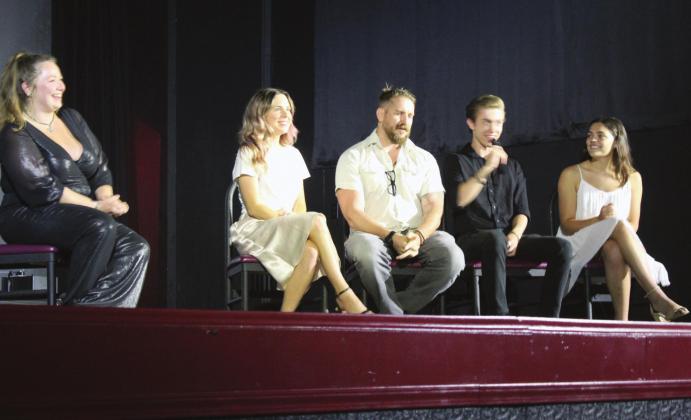
About 300 people gathered at the Ritz Theater in Shawnee on Friday, July 8, for a private screening of the short film called “The Ritz.”
For writer and director, Allex Tarr, who grew up in Shawnee, it was the culmination of a dream and a tribute to her grandparents’ love story.
Tarr’s friend and one of the film’s producers, Della Anderson, spoke about Tarr’s dream and dedication to completing it. Anderson compared Tarr to her grandmother, Delores (McWater) Woolery.
“Dolores, the film’s protagonist, is just like Allex,” said Anderson. “She is determined, sarcastic, free spirited, passionate, and really, really brave, because this isn’t an easy thing to do.”
Following the 15-minute film, Anderson moderated a question-and-answer session with Tarr and three of the cast members: Adam Hampton, of Shawnee, who played Tarr’s great-grandfather, Chester McWater; Ayden Layne, 17, of L.A., who played her great-uncle, Don Woolery; and Abby Miner, 22, of OKC, who played Delores. Lior Selve, of L.A., who depicted Johnny Woolery, could not attend due to making another movie in California.
Dan DeLorenzo took questions from the audience.
They asked about the casting process, how Tarr chose her actors, and how the actors learned about those they portrayed.
For Delores, Tarr said she wanted the actress to “be tough.”
“And I wanted her to be from Oklahoma because girls in Oklahoma are built different from the ones back in L.A.,” she said. “Abby here is talented and tough but sweet on the inside, too.”
Miner said she asked lots of questions about Delores, both from Tarr and from herself, in working out how her character would react and feel. She also considered the personal traits it would take to elope with her boyfriend at 16 in the 1950s.
“You had to think, too, of like the bravery that it took from her to do what she did, not only just in general, but like at the time that she did it,” said Miner. “Like, this was in the 1950s. This … is just not something that you did, but she was obviously in a really tough circumstance, and she decided to take it into her own hands and just do what she wanted to do, and I thought that that was incredibly brave.”
Layne said he was able to meet Tarr’s greatuncle Don, of Shawnee, and he was told several stories from which to draw inspiration.
“My great-uncle Don, he used to be the easybreezy guy, but he was very serious about his music, and he started playing jazz piano when he was 14,” said Tarr. “He really did, used to sneak into the back door of bars and play.”
“They would make him go wait in the alley in between sets and not let him drink, and he just couldn’t understand why. He played till this day. He’s 80-something, and he still plays jazz piano. He played all over the world.”
For her abusive great-grandfather, Tarr asked Hampton, who graduated with her cousins, to fill the role. Tarr said Hampton is the “nicest man in the whole world ... nothing like my great-grampa, luckily for all of us. But you know, he’s a good actor, so … he could act it.”
Hampton said, for any role, he tries to find a quality in the character that he can relate to. For Chester, he thought of his own daughter and the need to protect her. He said it helped to have talented actors on the set to “raise your game.”
There were questions about how long the film took to shoot, how much it cost to make and if there were any unexpected moments during the filming.
After writing the script in 2019 and having to postpone shooting because of the pandemic, Tarr spent countless hours planning out every detail of the film. In Oct. 2021, the actual filming in downtown Shawnee took three 12-hour days, and a budget of $23,000 that grew to cover the actual cost of $30,000.
Tarr said their production designer creatively camouflaged any feature on Main Street that didn’t fit into 1950, such as making flower boxes to cover the modern bike racks. But, during the final scene, there was timing that couldn’t be controlled.
“That Boomerang diner across the street, had all their customers come out at once,” she said. “And so, you can see them walking in the reflection in the glass behind the curb, if you look very, very closely, but … no fault of theirs, by any means.”
One audience member asked what Tarr’s grandparents would think of the film. Tarr said her grandfather, who thought the world of her, would love it, while her grandmother might be more critical but still proud.
Asked what her next project might be, Tarr, who lives in Los Angeles now, said she has written a full-length feature film about a college girl, which would spend 90% of filming in Oklahoma. She is just waiting for the funding.
“The hopes are to make it one day. Making movies especially with strong female leads like Abby here,” she said. “Yes, super important to me.”
Another producer on the film, Melanie Hooks, presented Tarr with a painting of the Santa Fe Depot, and Tarr said her grandfather used to take her there when she was a child.
Tarr plans to premiere “The Ritz” at a film festival next, and after that, she will upload it to the internet. She hopes that viewers will then share the link on social media.
Shawnee Film and Music Office Director Stacy Cramer Moore, who introduced Anderson at the screening, said there have been three other productions made in Shawnee, since they earned the “Film Friendly Certification Program” last year. “Out of Exile”- also starring Hampton - is a feature film in distribution, which recently won “Best Oklahoma Feature” at the deadCenter Film Festival. “Neon Cactus,” directed by Chris Zuhdi, just finished filming, and “The Joneses,” by RHS Productions, is a web-episodic.
There are also proposed productions which are scouting locations.
“If someone has a location, they can submit it to bit.ly/film-shawnee,” said Cramer Moore. “Locations should be visually interesting, but not necessarily the nicest house or business on the block. The property owner and film production company work together to see if it is a fit prior to any filming at that location.”
