

A wall of water rolled toward the valley. There was no time to wonder where it came from.
Army Second Lieutenant William “Bill” Ford gave the march order to the few members of his firing platoon who were with him to get out quickly. After using one of his vehicles to block the water, one vehicle escaped, but his and another vehicle were trapped in a knoll.
Ford made the call for a Huey helicopter to rescue them. Then, he noticed several Korean huts and decided they also needed to be rescued. “We hurried down there real quick, and opened the doors and hollered at them, … and they were within 30 minutes of drowning, and the fear on their face(s), you’ll never forget, and we got them out of there,” said Ford.
“ ‘Yeogiwa, yeogiwa.’ There were, I don’t know, five or six families, and ‘yeogiwa’ is ‘come here.’ ‘Palli, palli’ means ‘hurry.’ They could tell we were excited, and we got them all out and brought them up to where we were going to be evacuated.”
“And the helicopter came, and we got them out first, every one of them. Men and women … and children. And so, when they came back to get us, there were three or four of us, the water had come up. And … the dry land was about like from here to the front door (maybe 30 feet).”
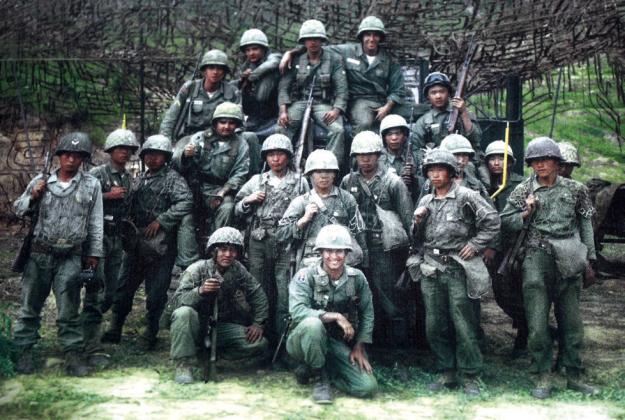
Ford was stationed just south of the Demilitarized Zone (DMZ) at Camp Page, South Korea, leading the 4th Missile Command in the First Missile Battalion of B Battery, 42nd Artillery.
With the help of a support group from Camp Page, Ford worked with a firing platoon of nine men to train members of the 1st Republic of Korea Army. From Dec. 1964 to Dec. 1965, they operated the MGR-1 Honest John nuclear capable rocket system to keep the Communist North Koreans honest.
“We ran fire missions along the DMZ, so North Korea would know that we were there and to not cause trouble,” said Ford. “And they still tried. Yes, we had infiltrators.”
“ ... See, Korea today is like it was in 1953. There’s a cease fire, but there’s no peace treaty, so ... there’s the difference. So both sides are totally armed.”
Ford said he and the Korean soldiers spoke a limited amount of the other’s language, but they respected each other.
“It’s amazing. Your barriers are broken down,” he said. “When people know that you can be respected and you respect them, and we train on an object. And so, in the artillery we trained together, and so we had a lot of respect for each other.”
Ford also taught his platoon to respect the Korean residents in surrounding villages.
“The one thing that I wanted to show the men and told them, was when we went by them with our vehicles, we slow down,” he said. “I never want to get the dust on them. I wanted to show total respect to them, and because of that, they knew we were the only American unit up there, they would wave at me. And they were very, very appreciative of how we respected them.”
In addition to leading the firing platoon, Ford was in charge of making sure the area roads were passable despite severe weather. He rode around with his driver Averrill Mc-Clure, who was from West Virginia, and they “put over 5,000 miles on that Jeep in those mountain roads in one year,” he said.
Ford bought Mc-Clure a camera after designating him the platoon photographer.
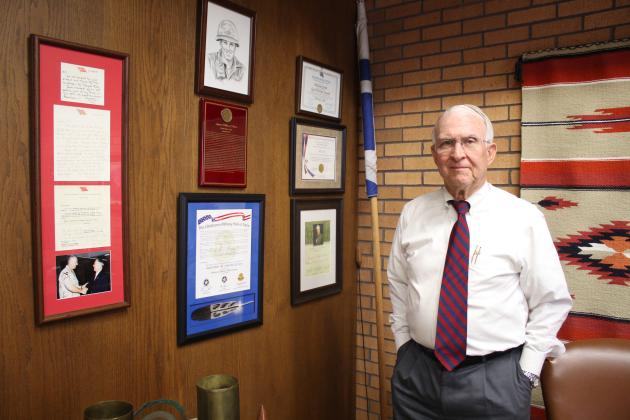
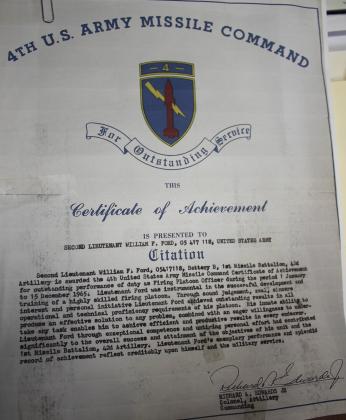
Following his time in Korea, Ford received a Certificate of Achievement for outstanding performance of duty that stated, “Lt. Ford was instrumental in the successful development and training of a highly skilled firing platoon. Through sound judgement, zeal, sincere interest and personal initiative Lt. Ford achieved outstanding results in all operational and technical proficiency requirements of his platoon.”
“His innate ability to produce an effective solution to any problem, combined with an eager willingness to undertake any task enables him to achieve efficient and productive results in every endeavor.”
In addition, Ford was inducted into the Oklahoma Military Hall of Fame in 2019.
Nevertheless, Ford points to his men.
“The main thing, I was proud of my men,” he said.
Besides doing their “job very well,” Ford is proud that they have stayed in touch. In 2013, Ford arranged a reunion in Shawnee where they visited Shawnee Milling Co., where Ford is the president; Ford’s church, and Fort Sill.
Before going to Korea, Ford graduated from the University of Oklahoma Army Reserve Officers Training Corps (ROTC) program, and he learned to drive four military vehicles so he could get his Korean driver’s license. Before that, he is proud to have earned his Eagle Scout rank. He still has his draft card, Korean driver’s license, and Eagle Scout card, as well as his Army Reserve ID, which states his service is “Indefinite.”
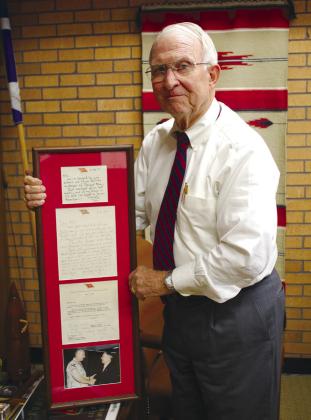
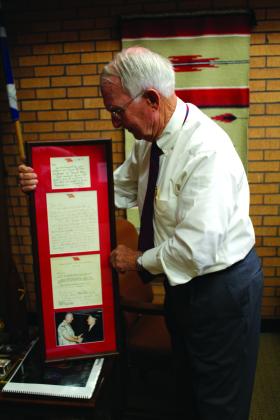
When he returned from Korea, Ford was in charge of training soldiers to become officers in U.S. Army Artillery and Missile Officer Candidate School at Fort Sill. One of his “candidates” was Tommy Franks, who would go on to become a four-star general. Ford has kept in contact with his famous student, who calls him “Tack” for tack officer.
“He was just a real skinny boy from Wynnewood, Oklahoma, when I got him,” said Ford. “He’s done a lot of wonderful things, but those letters I saved from him, you can see the one star, two star, four star (stationery). … I’ve saved that just because he’s just a downto- earth guy.”
Ford said they would get 100 candidates, and usually 25% of them would drop out because they were lacking the right attitude.
“It’s about service. Everything is from a lieutenant, as you’re trained, it’s about serving others,” said Ford. “You serve the men in your platoon. You serve the civilians that you come in contact with. It’s not about you. It’s all about service.”
After serving in active duty and achieving the rank of Captain, Ford joined the 95th Infantry of “Ready Reserves” in Shawnee. During two-and-a-half weeks in the summer, they would go to Fort Polk in LA to train soldiers in advanced individual training (AIT) courses. He did that for six years. He also completed his Masters Degree in Business at OU and married his wife Nancy of 55 years. They have three children and nine grandchildren.
In 2005, Ford and Korean War veteran Tom Smith started the Oklahoma Veterans Memorial Committee and worked with architect Don Price and Shawnee mayor Chuck Mills to plan for a memorial area. They looked at the memorial in Tecumseh, but decided their “vision would be much bigger.”
“We went back to the City, and they let us take that park area, right west of the old Municipal Auditorium and build that memorial,” said Ford. “And I think today, you see, it’s a very respected memorial. It has a real classy look about it.”
“We didn’t junk it up or anything, and Don helped us lay it out where it … had a longevity to it, and those names on those panels at the back, there’s over 7,000 names of Oklahomans that were killed in combat since the Spanish American War.”
The latest monument at Woodland Veterans Park - the Gold Star Families Memorial Monument - will be unveiled and dedicated tomorrow (Nov. 11) during a ceremony at 11 am. Gold Star members Donna Warren and Ford’s wife, Nancy, will participate in the unveiling. There will also be a public reception, especially for Gold Star Families, at the Senior Center following the program.
When asked what legacy he wishes to leave, Committee President Ford said, “The main thing was always be fair to your family, to your workers and your friends. Be truthful and honest and work hard. If you learn to work hard, it’s just important that you set a good example.”
