


Ever heard the saying, “A man’s home is his castle.”? Webster defines a castle as “a large fortified set of buildings with high walls and towers and a strong gate often belonging to a nobleman.” In a footnote, the buildings are identified as living quarters for family, staff, and guards, as well as a chapel and grounds for a garden, woods, and walking paths. Sometimes it may hold a dungeon. Castles are missing from North America. Castles are a big drawing card for tourists to the British Isles, where I recently traveled and visited four different ones.
Castle Cornet was a large medieval island castle in Guernsey, formerly known as Cornet Rock. It was fortified between 1206 to 1256 by the English and later by the French. It was both a military garrison and a military prison since it has a dungeon. Guernsey has turned it into a museum because it was given to them for their loyalty to the Allied forces in WWII. The cannon is fired at 1:00 daily as a warning to ships in the harbor. The ceremony was impressive, and the cannon shot was loud.
Dublin Castle (the seat of British Kings until 1922, when Ireland gained its independence) is today a major Irish government complex used for inauguration of Ireland’s presidents, hosting state visits and banquets, so it is fully restored. The mystery of the missing crown jewels of the last English monarch remains.
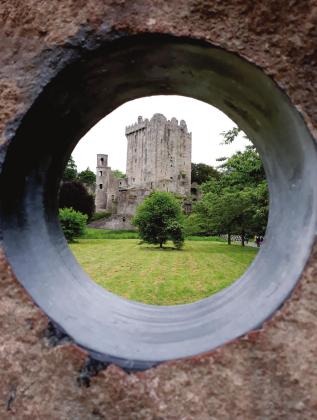
Another Irish castle is the Blarney Castle of 1210, that burned in 1446 and was rebuilt by Lord MacCarty. It was besieged during the Civil Wars and changed ownership many times. In the 18th century, it was purchased by the governor of Cork, who built Blarney House. The castle is in partial ruin, but its popularity lies in the legend that if you kiss the Blarney Stone, you will receive the gift of gab. Definitely not a gift I need, but I kissed it anyway after climbing the winding, narrow steps to the top.
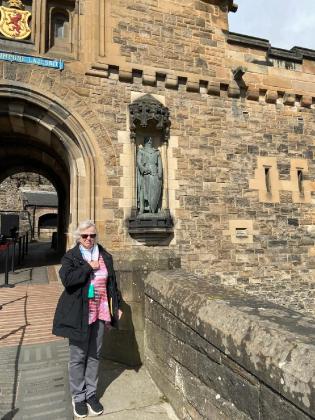
Edinburgh Castle stands on Castle Rock atop an extinct volcano since the 12th century, and the original St. Margaret’s Chapel still stands as the oldest structure in Edinburgh. (Queen Margaret died in 1093 after the loss of her husband, King Malcom III.) It remained a royal residence until 1633 and still houses the Crown Jewels. It was a stronghold during 26 sieges in its 1100-year history and stands impressively over Edinburgh.
These stone castles remain as symbols of Ireland and Scotland citizens’ long history of strength, loyalty, forbearance, and love of country against all odds.
